West Virginia just sent its Alyssa’s Law bill to the governor’s desk. South Carolina’s Senate panel advanced a companion bill on March 18th. Kentucky and Illinois each introduced their own versions in the opening weeks of 2026. The momentum is real, and it’s accelerating.
In the districts that are rushing to comply, there’s a bit of a problem developing. Administrators are checking off their boxes, vendors are promising compliance, and schools are left with systems that meet the letter of the law but not its intent.
A National Movement With Local Variations
Named after 14-year-old Alyssa Alhadeff — one of the 17 people killed in the 2018 Parkland shooting — Alyssa’s Law began in New Jersey and Florida. It has now been enacted or is actively advancing in more than a dozen states. West Virginia’s House Bill 4798 passed both chambers with unanimous votes this month and heads to the governor’s desk, joining a growing cohort of states that have moved from awareness to mandate.
What often gets lost in the coverage is that these laws are not identical. They share some commonality, including requirements for staff to have a reliable, wearable panic button that triggers an immediate emergency response. Nevertheless, the specifics vary significantly by state.
Utah requires wearable panic buttons, live video feeds, remote door locks, and two-way communication. Washington adds live video access for first responders. Georgia’s version mandates facility mapping and anonymous reporting systems alongside panic alert technology, with a compliance deadline of July 1st, 2026. Texas required silent panic alert technology in every classroom by the start of the 2025–26 school year.
This variation matters. A system that achieves full compliance in New Jersey may fall short in Georgia. A vendor who claims their solution is “Alyssa’s Law compliant” without specifying the state is selling a phrase, not a guarantee. K-12 administrators need to understand exactly which requirements apply in their state so they can ask their vendors to document, in writing, which of those requirements their system meets.
What “Compliance” Means in Practice — and Where Schools Get It Wrong
The most common misunderstanding among school administrators is that compliance is binary. Either you have a panic button or you don’t. In reality, most state laws specify functional requirements that go well beyond device ownership.
Location accuracy. Many panic button systems alert staff and law enforcement that something is happening. Fewer can tell first responders where in a building the emergency is occurring. Multiple state laws and federal funding frameworks now incentivize or require indoor location data as part of the emergency notification.
Testing and documentation. Some states require periodic testing of panic alert systems and documentation of those tests. A system that worked at installation but has never been formally tested since — or whose test results are unverifiable — may not meet the spirit of compliance. In some states, it doesn’t meet the letter of it either.
Network independence. This one is rarely addressed during procurement. A wearable panic button that depends entirely on school Wi-Fi creates a single point of failure. Power disruptions, network congestion during a mass emergency, or a cyberattack can all take down the same infrastructure that a Wi-Fi-dependent panic button relies on. The system that fails during an actual emergency isn’t compliant in any meaningful sense.
Self-management capability. Some state frameworks and funding requirements expect districts to demonstrate operational control of their safety systems. A system that requires a vendor call to add staff members, update floor maps, or verify device status creates practical problems. It may also create compliance ones.
Compliance Is a Condition, Not a Moment
Perhaps the most important reframe for any K-12 safety administrator is noting that compliance isn’t something you achieve once at procurement. It’s an ongoing operational condition that requires documentation, testing, and maintenance.
A school that was compliant on the day of installation may not be compliant 18 months later if devices haven’t been tested, staff turnover hasn’t been reflected in the system, or the network the system depends on has changed configuration.
The questions that matter aren’t just “does it have a button?” They are: Can we prove it was tested last month? Can we see which devices are active and which aren’t, right now, without calling anyone? If our internet goes down, does this still work? Can we show our school board, our insurance carrier, and a state auditor a clear and timestamped record of system health?
A System Built for This Reality
Punch Rescue provides a wearable panic button system designed specifically for K-12 schools, with compliance sustainability built into its architecture from the start.
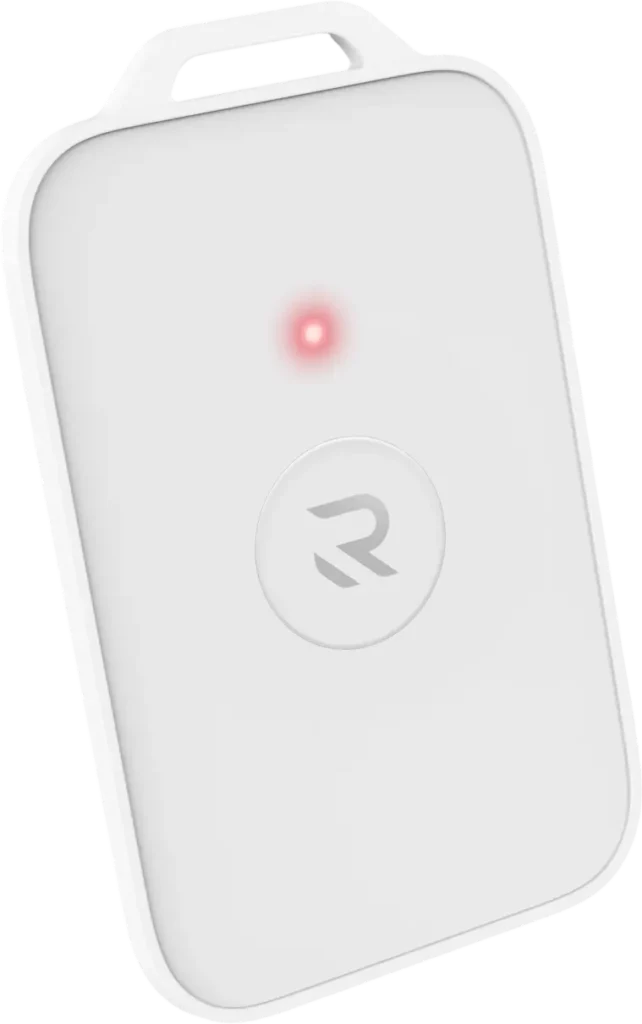
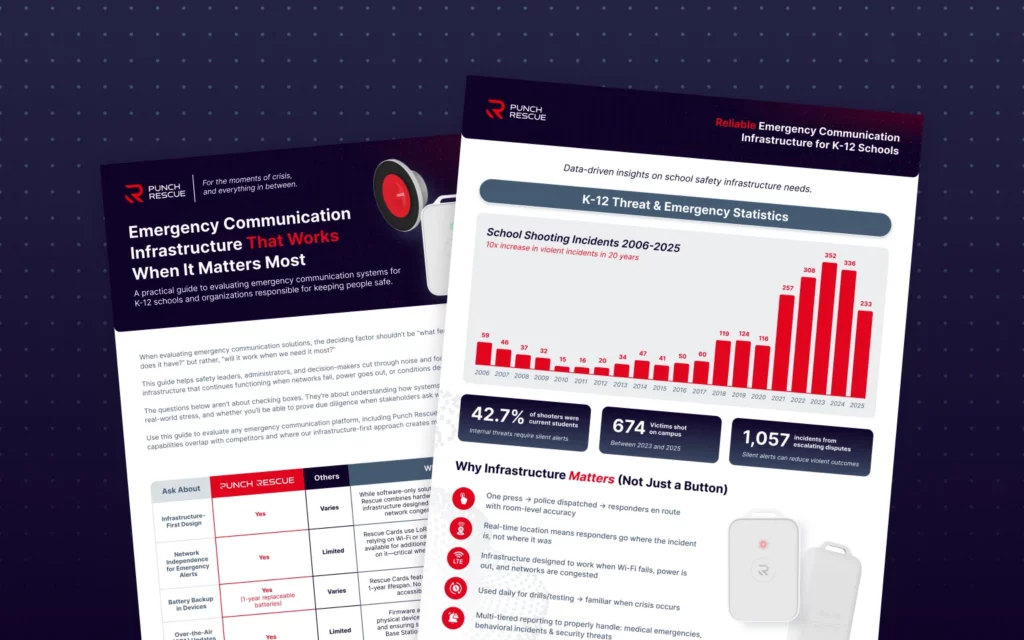
The Rescue Card is a wearable panic button for schools that operates on a dedicated LoRa mesh network independent of school Wi-Fi. That means an emergency communication network that continues to function even when the building’s general internet does not. Rescue Repeaters provide extended mesh coverage with 2–3 days of backup power; Rescue Base Stations bridge the network with approximately 6 hours of battery backup.
Every device activation is logged. Every Rescue Card can be tested remotely through Rescue’s built-in Test Mode, generating a timestamped record without triggering a live response. Device health (covering which cards are active and which base stations are online) is visible in real time through the self-managed Rescue console, without a support call or vendor visit.
As Alyssa’s Law continues to expand and evolve, the ability to document, test, and self-manage your emergency response system will only become more important. Punch Rescue offers the only panic button solution with real-time visibility and self-management. This is a system built not just to pass an audit, but to operate with confidence every day.
Learn more about how Punch Rescue approaches panic button compliance for K-12 schools at here.
Sources:
West Virginia HB4798 passes both chambers, heads to governor (March 2026): WV Legislature Blog
SC Senate panel advances Alyssa’s Law bill (March 18, 2026): WIS-TV
State-by-state compliance requirements: NovoTrax