Official reports from Parkland and Uvalde revealed critical emergency communication failures. What do these incidents teach about school safety infrastructure?
Inside this Article:
- Why Do Wearable Panic Buttons Matter?
- What Should Schools Be Asking About Emergency Systems?
- What Did Parkland and Uvalde Reveal About Emergency Communication?
When school emergencies occur, the systems designed to protect students and staff are put to their ultimate test. Official investigations into major incidents have revealed that emergency communication infrastructure often fails precisely when it’s needed most. This is a troubling pattern.
The lessons from Parkland and Uvalde aren’t just tragic stories. They’re documented evidence that should inform how schools evaluate safety technology today. Let’s consider what they have to teach us all.
The Parkland Radio System Breakdown
On February 14, 2018, a shooting at Marjory Stoneman Douglas High School killed 17 students and staff. The subsequent commission investigation uncovered critical communication failures that hampered response efforts.
The county’s radio system experienced “throttling.” This is a condition where too many users cause the network to block or delay transmissions. According to commission testimony, many first responders didn’t receive radio transmissions at all because the volume of traffic overloaded the system. Dispatchers reported officers “could hear nothing, just complete silence, because nobody was able to get on the radio.”
Officers from different agencies couldn’t communicate effectively due to incompatible radio systems. When radios failed, some officers resorted to hand signals.
This wasn’t a technology problem in the traditional sense. The radios worked fine during normal conditions. The system simply wasn’t designed for the extreme demand surge that real emergencies create.
Uvalde’s Communication Crisis
The May 24, 2022 shooting at Robb Elementary School in Uvalde, Texas, killed 19 students and two teachers. The Department of Justice’s 600-page Critical Incident Review documented “cascading failures of leadership, decision-making, tactics, policy, and training.”
Communication breakdowns occurred at multiple levels. The school district police chief, identified as the de facto incident commander, discarded his radios during arrival. At the time, he thought they were unnecessary. Some responders reported that radios didn’t function inside the building due to construction materials blocking signals.
The DOJ found that leadership “demonstrated no urgency for establishing a command and control structure, which led to challenges related to information sharing.” Critical coordination depended on tools that simply didn’t work when conditions degraded.
The Pattern Behind the Failures
These incidents reveal three consistent infrastructure vulnerabilities:
Network congestion during surge demands: Emergency communication systems often share infrastructure with routine traffic. When everyone tries to communicate simultaneously, networks designed for normal conditions become overwhelmed. This has been documented at Parkland, during the Boston Marathon bombing, and other major incidents.
Building structures that block signals: Many schools use concrete, steel, and energy-efficient materials that significantly impair radio and cellular signals. What works in a parking lot may fail inside a classroom. Dead zones in basements, stairwells, and interior rooms create gaps where critical alerts can’t reach.
Dependence on systems that require power and connectivity: Wi-Fi access points, PA systems, and network infrastructure all require electricity. During power outages or deliberate attacks on building systems, communication capability can disappear entirely.
Why Do Wearable Panic Buttons Matter?
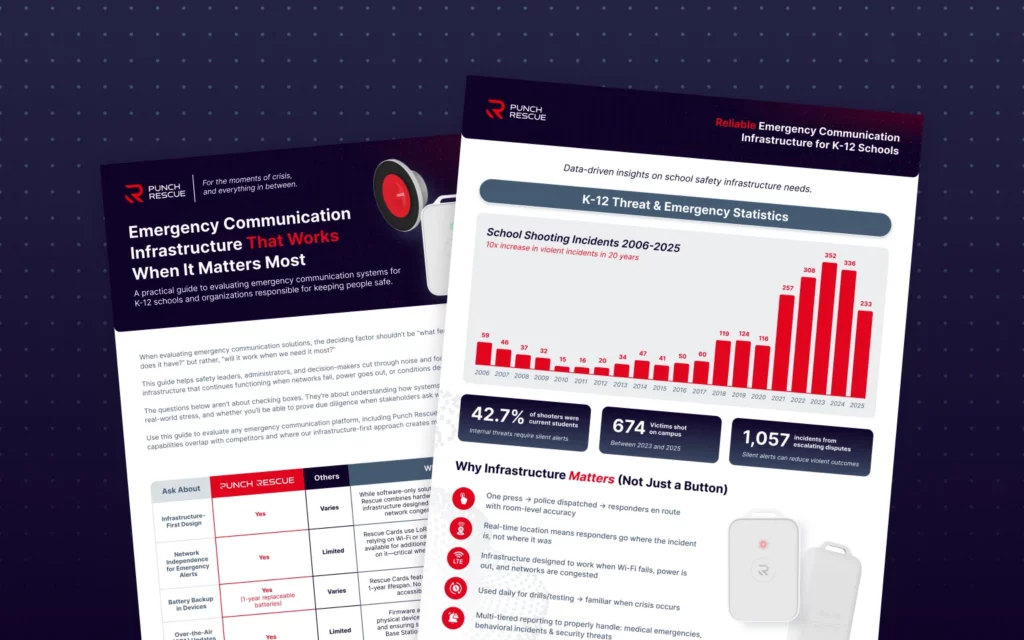
The contrast with Apalachee High School in Georgia is instructive. When a shooting occurred on September 4, 2024, teachers activated wearable panic buttons that had been issued just one week earlier. Over 20 alerts from staff in that general area helped responders locate the incident immediately. The suspect was in custody within six to seven minutes.
Sheriff Jud Smith credited the wearable emergency button system with preventing “a much larger tragedy.” What was the difference? The school had infrastructure that didn’t depend on staff unlocking phones, finding apps, or navigating menus under extreme stress.
What Should Schools Be Asking About Emergency Systems?
When evaluating emergency communication systems, schools should focus on analyzing system performance under degraded conditions. Faculty need to know:
- What happens when Wi-Fi loses power?
- What happens when cellular networks are congested?
- Can the system reach everyone in the building, including visitors and students without phones?
- Does activation require multiple steps, or can staff trigger alerts with one action while under stress?
- Does the system provide building-wide coverage, including areas with poor signal reception?
Infrastructure Over Assumptions
The documented failures at Parkland and Uvalde share a common thread. We see that systems designed for normal conditions broke down when conditions became abnormal. Emergency communication infrastructure should be designed for such degraded conditions from the start, with network independence, battery backup, building-wide reach, and simplicity under stress.
The students and staff in our schools deserve safety systems that work when it matters most, not just when everything else is going smoothly.
TL;DR: What Did Parkland and Uvalde Reveal About Emergency Communication?
Official investigations into Parkland and Uvalde documented how emergency communication systems failed under real-world conditions:
- Radio networks experienced overload and throttling during surge demand
- Building materials blocked signals, creating dead zones where responders couldn’t communicate
- Systems designed for normal conditions broke down when demand surged
- Power and network dependencies created single points of failure
What Should Schools Prioritize?
Schools evaluating safety technology should prioritize infrastructure that works during degraded conditions:
- Network independence that doesn’t rely on Wi-Fi or congested cellular networks
- Battery backup in devices and infrastructure
- Simple one-button activation that functions under extreme stress
- Building-wide coverage that reaches everyone, not just enrolled app users
The contrast with Apalachee High School, where wearable panic buttons enabled rapid response, demonstrates how infrastructure-first design can support faster, more effective emergency coordination.
→ Ready to Evaluate Infrastructure-First Emergency Communication?
Punch Rescue provides emergency response infrastructure designed to work reliably during any conditions. Contact our team to learn how infrastructure-first design can support your school’s safety preparedness.