When panic button systems depend on the same network everyone else is using, a crisis can silence the very tools designed to address it.
A Road Race Changed How America Thinks About Emergency Networks
On April 15, 2013, two bombs detonated near the finish line of the Boston Marathon. In the minutes that followed, cell towers in the area were overwhelmed. Tens of thousands of people simultaneously tried to call family members, reach emergency services, and post updates online. Networks weren’t built for that load. Calls failed. Text messages were delayed by minutes. The Federal Communications Commission later documented widespread communication failures across carriers in the affected area.
The federal response was to accelerate the buildout of FirstNet. This is a nationwide broadband network built specifically for public safety, with priority and preemption rules that prevent commercial traffic from crowding out emergency communication. The foundational legislation had already been passed earlier (prompted by the communication failures of September 11, 2001). The Boston incident made the urgent need more undeniable.
The logic embedded in FirstNet’s design is straightforward. It’s built on the idea that life-safety communication needs its own infrastructure. It cannot share bandwidth with the general public’s technology.
K-12 schools have not yet widely faced this reality and responded accordingly.
Push Notifications Are “Best Effort” by Design
Apple’s developer documentation states plainly that push notifications are delivered “best effort.” They’re not guaranteed to arrive in real time. The system is designed to be efficient under normal conditions, rather than under emergency conditions.
This architecture makes complete sense for alerts about software updates or marketing messages. It makes much less sense for a panic button for schools.
During an active emergency, network conditions are rarely normal. People are on their phones. Parents in the parking lot are calling in. Staff are trying to reach each other. Security cameras are uploading footage. The school’s Wi-Fi is under load it was never designed to handle. When a school’s emergency system routes its alerts through the same push notification infrastructure as everything else, it joins a queue that is, at precisely the wrong moment, backed up.
This isn’t a hypothetical failure situation. The FCC’s emergency communications reports have consistently identified network congestion as a first-order reliability problem. It’s faulty in disasters, in public events, and in any situation where large numbers of people suddenly try to communicate simultaneously.
The School Network Problem Is Structural
A school’s Wi-Fi network is built to serve classrooms. It’s provisioned for students browsing, streaming, and submitting assignments. It’s not suited for the communication demands of a mass emergency.
When safety vendors sell a system that runs over the school’s existing Wi-Fi, they’re making an implicit assumption that the network will be fine when it’s needed most. That assumption hasn’t been examined carefully enough.
K-12 IT directors are increasingly paying attention. A March 2026 analysis by eSchoolNews identified digital resilience — the ability of technology systems to remain functional when networks are degraded or unavailable — as one of the defining technology challenges for school districts in the coming years. Sooner than later, this will inevitably become a compliance and liability issue.
Alyssa’s Law panic button mandates are spreading to more states, and the statutes typically require that systems be tested and verified. What happens when a district’s chosen system is tested during a period of normal network load, passes that test, and then fails during an actual emergency because the network was congested? That’s a documentation problem, a liability problem, and a safety problem as well.
What Does Network-Independent Emergency Communication Actually Look Like?
The FirstNet model — dedicated infrastructure with priority preemption — is instructive. Public safety communication works best when it doesn’t compete with general-purpose traffic.
For schools, the equivalent design principle is that emergency communication infrastructure should operate independently of the school’s general-purpose network. That means a separate radio network, rather than a Wi-Fi-dependent one. It means confirmed delivery, not best-effort delivery. It means hardware that continues to function when routers go offline, when cellular towers are congested, and when power is interrupted.
It also means the ability to test that infrastructure reliably and document the results, without needing a vendor to run the test for you.
Where Punch Rescue Fits
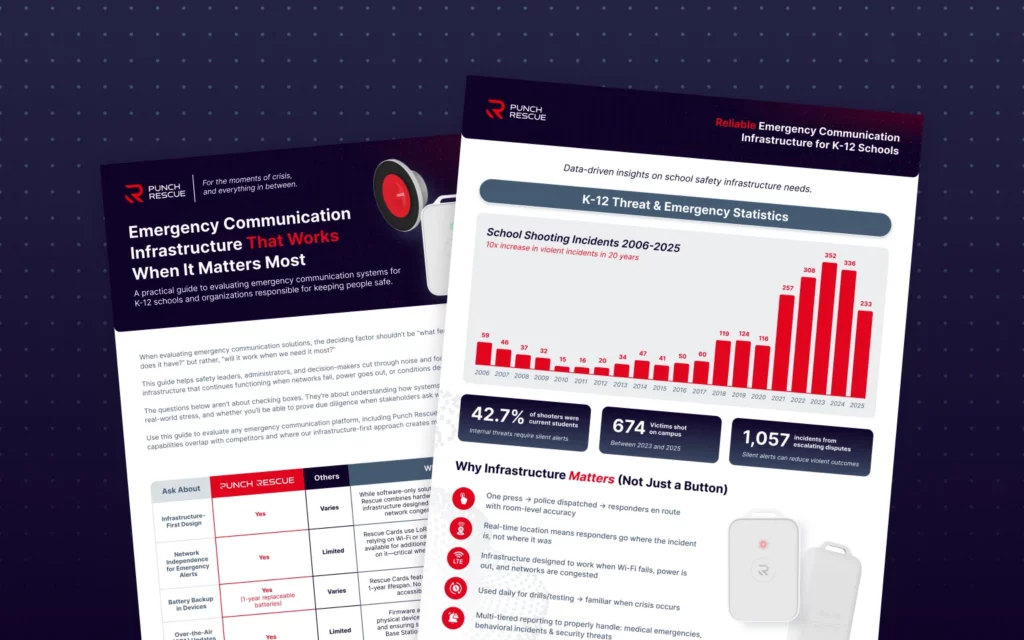
Punch Rescue approaches this as an infrastructure problem, not a software problem. Rescue Repeaters and Rescue Base Stations form a dedicated LoRa mesh network. This is a long-range, low-power radio protocol that operates completely independently of school Wi-Fi and commercial cellular.
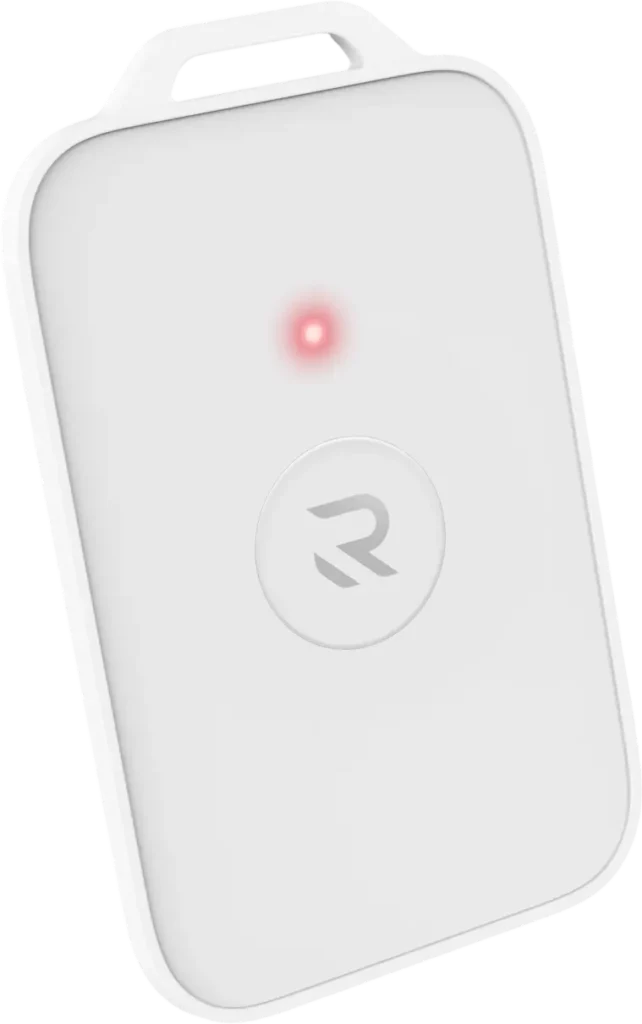
When a wearable panic button (Rescue Card) is pressed, the alert travels over that dedicated network. It does not have to travel through the Internet or a push notification queue. The system provides real-time visibility, and can be tested remotely without a vendor call.
For administrators working through Alyssa’s Law panic button compliance or building the case for infrastructure investment, that independence is the specification worth asking for.
Sources: FCC Emergency Communications Report (2013); FirstNet.gov; Apple Push Notification Service developer documentation; eSchoolNews, “Why digital resilience is critical for U.S. K-12 schools,” March 23, 2026