
In October 2025, New York City became the first city in the nation to pilot a direct-to-911 panic alert system across 51 public schools. The announcement drew significant attention for good reason. What made the initiative notable was the program’s unique tech. When seconds count and stress is at its peak, the kind of system that works effectively is determined by human factors. This was clearly kept in mind by the technology’s designers.
What Happens to the Brain in An Emergency?
Researchers have studied stress-induced performance degradation for decades. They’ve studied people working in aviation, nuclear operations, military environments, and emergency medicine. The findings are remarkably consistent, having direct implications on how school safety tools should be designed.
The Yerkes-Dodson law, first described in 1908 and extensively validated since, captures an inverted-U relationship between nervous-system arousal and performance. Moderate arousal sharpens focus. Extreme arousal — the kind produced by an active threat inside a school building — degrades it significantly. Fine motor control deteriorates. Working memory capacity shrinks. The ability to navigate unfamiliar sequences of steps collapses.
What replaces nuanced decision-making under extreme stress is a well-documented combination of physiological responses. Tunnel vision narrows a person’s usable visual field to a small central area, filtering out peripheral cues and information. Auditory exclusion (sometimes called “tunnel hearing”) causes people to stop processing ambient sound. This includes intercom announcements and digital notification tones. Time distortion makes seconds feel stretched or compressed in ways that disrupt procedural memory.
The implications are serious. A teacher or administrator under extreme stress may not hear a voice announcement, may not be able to navigate a multi-step app interface, and may not register a phone notification on a screen they aren’t already focused on. Their issue isn’t poor training or lack of composure. It’s basic neuroscience.
What Aviation and Aerospace Got Right
The aviation and aerospace industries confronted these exact challenges decades before K-12 safety technology became a serious design discipline. NASA and the FAA built their safety protocols around the idea that when cognitive load is at its highest, the number of required actions must drop to its lowest.
This principle shows up everywhere in cockpit and mission-critical interface design. Emergency checklists are short, sequenced, and physically distinct from normal operating procedures. Critical warning systems use simultaneous channels (visual and auditory) to break through the tunnel focus that extreme stress produces. The most safety-critical actions are designed to be executable with a single physical gesture, without fine motor precision, and without reference to a separate device.
The FAA’s Human Factors Design Standard specifies that emergency controls must be operable without fine motor precision and must produce unambiguous confirmation that the action occurred. These are life-safety requirements built on decades of incident analysis and post-mortem research.
K-12 emergency communication infrastructure has not, historically, been held to anything approaching this standard.
Where Do Current School Emergency Tools Fall Short?
Many current school emergency notification approaches require multiple sequential steps to activate. This includes mobile apps, software-based panic buttons, and intercom systems. They depend on Wi-Fi or cellular networks that can become congested or fail entirely during high-traffic emergencies. Many provide no physical confirmation that an alert was successfully sent. Some require a staff member to unlock a phone, navigate to an app, and complete multiple taps before an alert goes out.
Under normal conditions, this takes a few seconds and causes no problem. Under the cognitive load described above (tunnel vision, elevated heart rate, auditory exclusion, degraded fine motor control), those steps become genuine barriers to timely activation.
Post-incident analyses have identified this pattern. The DOJ investigation into the Uvalde response documented how communication failures contributed to a delayed and disorganized response. The post-mortem on the Virginia Tech shooting raised questions about alert system delays. In both cases, the systems in place were technically functional. They simply weren’t designed for the humans who needed to use them under the conditions that actually existed.
What Does A Human-Factors-Informed Design Require?
A school emergency tool designed with these principles in mind looks different from most current products. It activates with a single physical press. There’s no need for a phone to unlock, an app to be navigated, or a confirmation dialog. It provides immediate, unambiguous feedback visible from a distance (rather than an on-screen notification). It does not depend on network infrastructure that may be congested or unavailable when the emergency occurs. And it works exactly the same way every time, including during the drills that build the procedural memory staff need when real stress arrives.
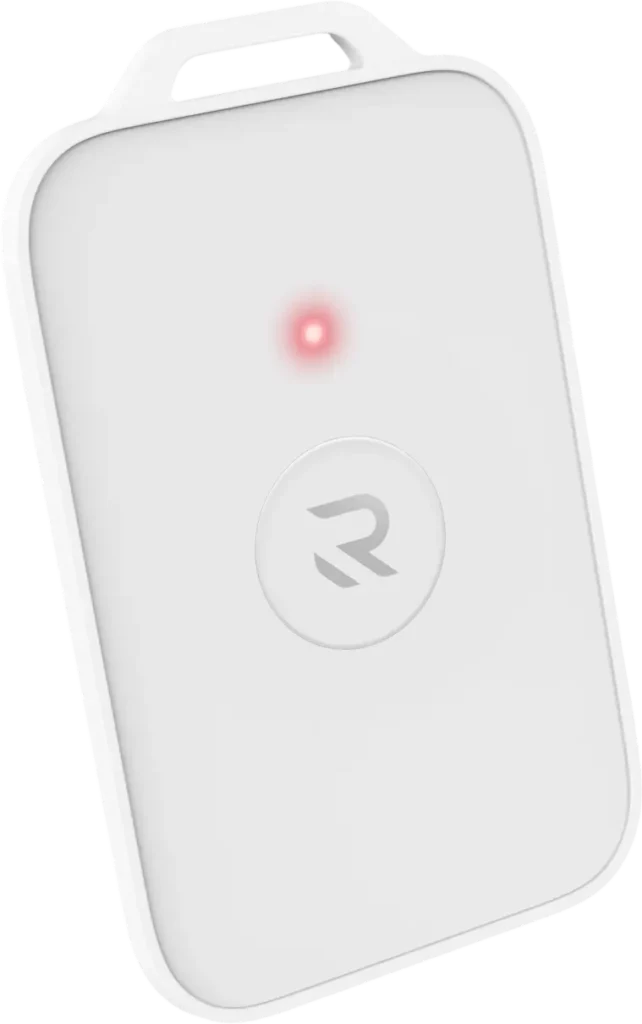
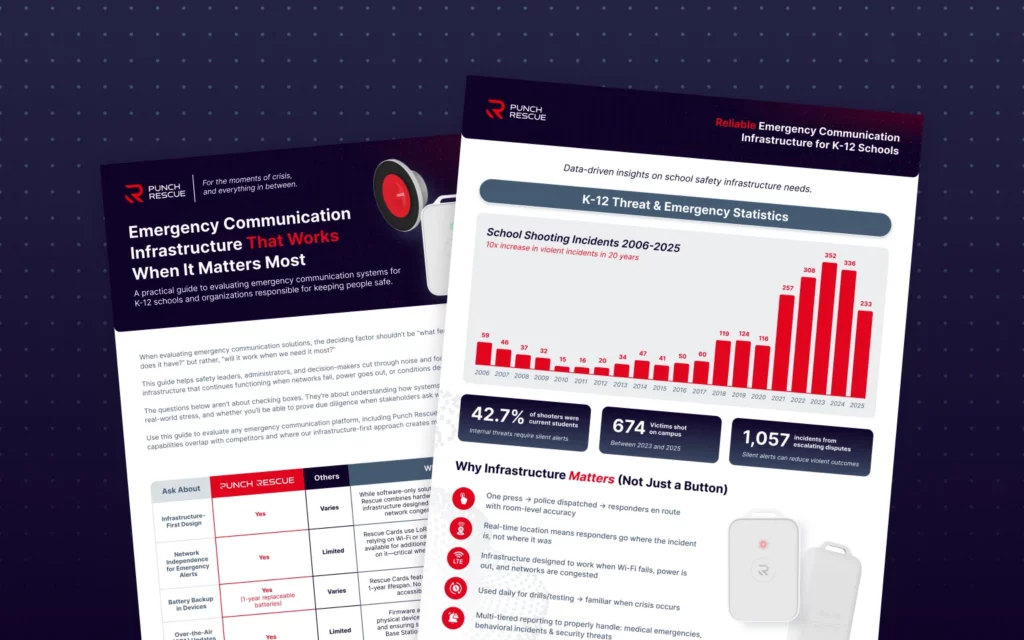
This is the design philosophy behind Punch Rescue. Rescue Cards — the wearable panic buttons in the Punch Rescue system — are built for single-press activation with clear visual feedback. Because the underlying network uses LoRa mesh rather than Wi-Fi or cellular, alerts travel independently of the building’s internet infrastructure. The Rescue software gives administrators real-time visibility into both device health and active alerts. Staff know the system is ready before an incident, not only during one. Punch Rescue provides the only panic button solution with real-time visibility and self-management, designed from the ground up for the real cognitive conditions staff face under stress.
K-12 administrators evaluating emergency communication infrastructure would do well to ask the same questions NASA and the FAA have required engineers to answer for decades:
- What does this system ask of a person in crisis?
- And is that something a person in crisis can actually do?
Sources: NYC Mayor’s Office press release, October 2025 (nyc.gov); Education Week, “New York City Is the Latest to Deploy Panic Buttons in Schools,” October 2025 (edweek.org); Yerkes-Dodson law background via Wikipedia and Simply Psychology.