Free Pilot: Punch Rescue + Lightspeed Notify | May 5, 1PM EST | Register for Webinar

Product Updates

August 3, 2026

Firmware Visibility Across Every Device

We’ve been quietly shipping improvements to the admin experience. Here’s what’s new:

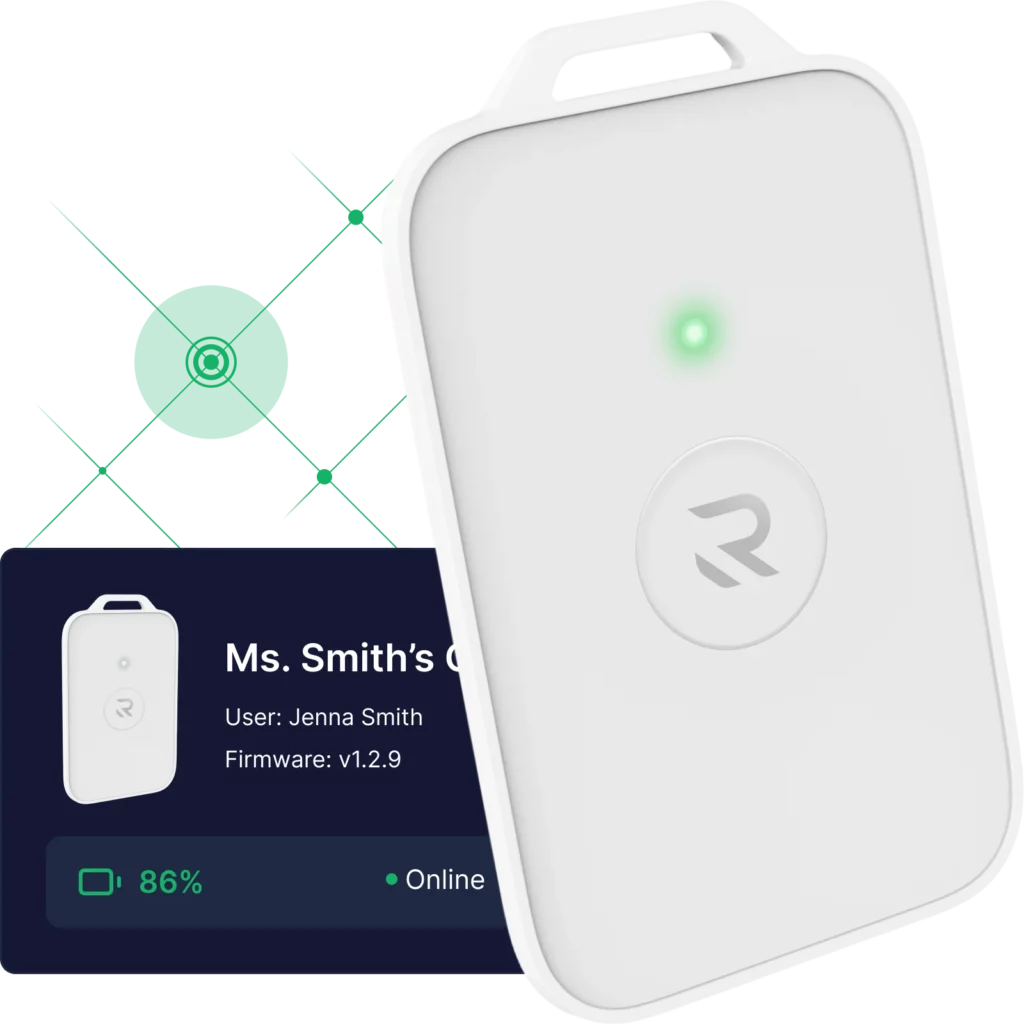
Your dashboard now shows the firmware status of every device at a glance. Up to date or update pending, you can see the state of every card and repeater, along with the date and time of its last update. No more guessing which devices are current.

When a new firmware version is ready, an update banner appears. From there, you can push the latest firmware to your Cards and Repeaters over the air, no collecting devices, no cables.

Keeping devices current matters beyond just maintenance. Some of our newest dashboard and map capabilities only work on the latest firmware, so staying up to date means your team gets every improvement the moment it ships.

Multi-factor authentication for admin accounts

Admins can now enable multi-factor authentication on their accounts, adding a second verification step at login. It’s a straightforward way to make sure your organization’s emergency setup stays in the right hands.

SSO for Enterprise customers

Enterprise customers can now sign in using Single Sign-On, making access management simpler and more secure at scale.

These updates are part of an ongoing effort to make the platform easier to operate and harder to compromise. More improvements are on the way.

July 7, 2026

How Punch Rescue Connects to 911

When someone presses their Rescue Card, here’s how Punch Rescue gets the right information to 911, fast.

Our primary integration: RapidSOS

Our core 911 integration is built on RapidSOS, a network connected to every 911 center in the US, over 6,000 centers, directly into their dispatch systems.

When an alert is triggered, we send the emergency category, the location, who reported it, and the name of the organization, all in real time. As the situation develops and the location changes, we update that too.

There’s also a human in the loop. A monitoring center agent is aware of the emergency and calls the 911 center directly to confirm and communicate the details. This matters because 911 centers still default to phone calls, and a silent alert alone isn’t always enough to guarantee a response.

Real-time maps for first responders

Along with the alert, we send a link to our real-time map. A first responder on the way, or a dispatcher at the center, can pull it up on any device and see all staff locations in real time, find the person who reported the emergency, filter by responders, staff, or visitors, and locate assets like AEDs and fire extinguishers. The map is read-only and expires at the end of the emergency.

For K-12 customers

Dispatch is immediate; there is no confirmation step and no delay. A long press or triple press tied to an active threat sends an active assailant or silent panic alert straight through to the 911 center, and the monitoring center agent calls simultaneously.

For non-K-12 customers

For healthcare, corporate, industrial, and other settings, there’s a validation step before dispatch. It works like this:

  • A 30-second countdown goes to the web and mobile app. Confirm or cancel.
  • If no response, an SMS goes to a designated number. Another 30 seconds to reply.
  • If no response, an automated phone call goes to that same number.
  • If still no response, a live monitoring center agent calls to confirm.
  • If they can’t reach anyone after all of that, they dispatch.

It’s a thorough process that protects against accidental alerts while ensuring help gets through when it’s needed.

Additional 911 integrations

RapidSOS is our primary and most comprehensive integration, but we also support customers using STOPit Notify and SaferWatch, both of which connect to a broad network of 911 centers and emergency agencies.

Our approach to 911 is probably the most comprehensive in our space, and the real-time map access for first responders is something we haven’t seen anyone else provide.

June 23, 2026

Mobile Mode: Emergency Coverage Beyond the Building

The Rescue Card was designed for buildings, but emergencies don’t only happen in buildings.

Mobile Mode is a feature in the Rescue app that extends card functionality off campus. When enabled, a Rescue Card communicates through a nearby smartphone instead of the building’s repeater network, allowing staff to report emergencies and share their real-time location from anywhere.

Mobile Mode is particularly useful for:

  • Field trips, where staff are away from campus with students
  • Mobile health workers moving between locations
  • Any role that regularly takes staff outside the building

How it works

When Mobile Mode is active, pressing the card triggers an alert through the user’s nearby smartphone. Location is shared via the phone, so responders know where the person is even without building infrastructure nearby.

When staff are off the clock and don’t want to risk accidental alerts on personal time, they can simply turn Mobile Mode off; the user controls it.

One card, everywhere

The same card staff wear every day in the building now works beyond it. No extra device, no separate app flow. Just the existing infrastructure extended to wherever the work actually happens.

June 9, 2026

Rescue Intelligence

Most safety platforms are adding AI features: A chatbot here, a generated report there. In most cases, it’s AI added onto systems that weren’t built with ‘intelligence features’ in mind.

The way we’ve architected Rescue Intelligence is different. The data and integration layer has been the foundation underneath everything we’ve built.

What’s already live

Two AI-powered tools are already deployed and in use:

  • AI after-action reports analyze what happened during an emergency and surface what could be done better, automatically, without someone having to piece it together manually.
  • AI mapping helps administrators figure out optimal device placement across their facility, so coverage decisions are informed rather than guesswork.

These are currently running in our platform today.

Where Rescue Intelligence is going

Our roadmap builds toward something more significant: a safety intelligence hub with an agentic workflow engine. 

Think of this as the central nervous system for safety intelligence. Information flows in from across the organization, is automatically connected and analyzed, then used to determine where attention, communication and action should occur.

In practical terms, that means agents working in the background to keep your system healthy, monitoring devices, flagging issues proactively, and taking action before problems become failures. It means custom workflows that combine reliable, rule-based decision making with agents that can interpret unstructured data like audio and video.

We’re bringing on Agent Deployment Engineers to build custom integrations for partners, connecting Rescue Intelligence to third-party systems like video surveillance and access control. Our APIs and webhooks are already built to support this.

The direction we’re building 

Our goal is to give our customers a centralized place where safety intelligence compounds over time. 

  • After-action reports that pull from every data source in the building. 
  • Proactive alerts before a device goes offline. 
  • Agentic workflow engine built that protects all customer data.
  • IoT multi-device data ingestion for comprehensive safety assessments.

The more data that flows into Rescue Intelligence, the more useful it becomes.

May 23, 2026

How Much Power it Takes for Real Time Visibility

There is a reason our repeaters get plugged into standard wall outlets, not just stuck to a wall.

Punch Rescue repeaters are installed in every room and plugged into a power source. That might mean using an existing outlet, or it might mean a small amount of electrical work to add one. Compared to the battery-powered beacon stickers competitors mount on walls, this requires a bit more upfront effort.

It’s also the reason our system can do things others can’t.

More Power = More Possibilities

A sticker beacon on a wall is simple to install. It’s also a battery-powered device that can die, go unnoticed, and fail quietly. Over time, maintaining a building full of them becomes a real operational burden. Batteries degrade, devices get forgotten, and in a system where every node matters, a dead beacon is a gap in coverage.

Repeaters with a steady external power source don’t have that problem: It’s on, it stays on, and because it has consistent power, it can do significantly more.

That consistent power is what enables:

  • Real-time location visibility for every card, at all times
  • A mesh network with a gateway in every room
  • Greater redundancy at every layer of the system
  • The reliable infrastructure behind our patent-pending architecture

The trade-off is worth it

More capability requires more infrastructure; that’s true in any field. The question is whether the investment is justified by what you get in return.

For emergency systems, the answer is straightforward. A system that requires minimal installation but delivers inconsistent coverage isn’t actually simpler when it matters. It’s just simpler to set up.

Plugging a repeater into an outlet isn’t a major construction project. It doesn’t require Ethernet runs or complex wiring, it just requires power. That power is what turns a basic alert system into reliable emergency infrastructure with real-time awareness across an entire building.

That’s a trade-off we think is more than worth it.

May 8, 2026

Over-the-Air Updates

Most emergency devices stay the same forever. If something needs to be fixed or improved, the device has to be physically replaced or sent back. That’s how most of the industry still operates; Punch Rescue was built differently.

The entire Punch Rescue system supports over-the-air (OTA) software updates. Base stations, repeaters, and Rescue Cards can all receive improvements remotely, meaning better performance, bug fixes, and new functionality reach the full system without touching a single device.

Since early deployment, we’ve pushed updates that improve how cards communicate, how accurately they report location, and how flexibly they can be configured. The cards customers have today are better than the ones they installed, with no replacements required.

How OTA updates work across the system

We’ve expanded how updates reach devices over time:

  • The mobile app can update a single nearby card
  • The mobile app can update multiple nearby cards at once
  • Repeaters can now deploy OTA updates to cards automatically, with no customer involvement required

That last step matters. It means updates reach cards the same way we already handle updates for base stations and repeaters: quietly, reliably, and without adding work for IT teams.

Why this is a bigger deal than it sounds

Think about any modern device you use regularly. An Apple Watch, a laptop, or a wearable fitness tracker. All of them improve over time through software. None of them require you to ship them back.
Emergency devices should work the same way.

When a device can’t be updated, bugs become recalls. Improvements become replacement programs. And customers are left managing hardware cycles instead of focusing on preparedness.

Based on what we’re hearing from customers and partners, Punch Rescue appears to be the only panic button in the space that supports over-the-air software updates across the entire system. Competitors are dealing with recalls. We’re deploying improvements.

Built for the future

Punch Rescue has built a platform that gets better over time. As the Rescue Card evolves to support broader use cases, including identification, access control, and emergency response, the ability to deploy updates without hardware swaps becomes foundational.

Removing that friction opens up a lot of possibilities.

Panic buttons with reliable emergency infrastructure.
A Punch Rescue Rescue Card wearable panic button overlaid a green grid graphic and a screenshot of the Rescue Dashboard.
How We Started

In 2017, a young lifeguard at a YMCA of Charlotte branch suffered a seizure while opening the pool alone. She fell into the water and drowned before anyone knew she needed help.

We heard the full story later that year at a conference in Seattle. Our emergency communication platform, PunchAlert, was already deployed at that YMCA, but it couldn’t help. She couldn’t unlock a phone, open an app, or call for assistance.

That tragedy exposed the fundamental constraint: when people need help most, they often can’t use the tools we’ve given them. We spent two days in Seattle with aquatics directors and risk managers, determined to solve what software alone couldn’t. The answer wasn’t another app, it was infrastructure designed for the worst-case scenarios.

Punch Rescue was born from that commitment: wearable devices that work when nothing else can, connected to infrastructure that doesn’t rely on the person in crisis to operate it. From aquatics to K-12 schools and beyond, we’ve remained focused on one principle: protecting the people who matter most, especially when they can’t protect themselves.