- Bill: A764
- Read the Full Legislation

BJA STOP School Violence Program: The FY26 cycle reopened September 21, 2026. It offers 15 awards up to $2M (for state/public higher ed) and 80 awards up to $1M (for districts, nonprofits, private K-12, and tribal governments). The Grants.gov deadline is October 30, 2026. The JustGrants deadline is November 6, 2026. You may also join this email newsletter for ongoing updates on upcoming grant opportunities.
New Jersey A764 requires every public elementary and secondary school building to be equipped with:
Alyssa’s Law is state legislation requiring K-12 schools to install rapid, direct-to-911 panic-alert technology, so any classroom can call for help in a life-threatening emergency without an intercom announcement. New Jersey’s version was the country’s first, and it remains the most administratively demanding to comply with.
Yes. New Jersey’s Alyssa’s Law, A764, requires every public school building to have at least one silent panic alarm linked directly to local law enforcement. Compliance is certified building by building through the state, not district-wide, and gates access to state security grant funding.
Alyssa’s Law is named for Alyssa Alhadeff, a 14-year-old student killed in the February 14, 2018 shooting at Marjory Stoneman Douglas High School in Parkland, Florida. Her parents became leading voices pushing for school safety reform. They advocate for legislation that would give every classroom a direct, silent line to law enforcement during an emergency (without triggering school-wide alarms that could escalate danger or tip off a threat).
New Jersey was the first state in the country to answer that call. Governor Phil Murphy signed Assembly Bill A764 on February 6, 2019. The bill had strong bipartisan support and went into effect September 1, 2019. Since then, more than a dozen states have passed their own versions. New Jersey’s law serves as the model from which the national movement grew.
All public elementary and secondary school buildings in New Jersey must comply. The law applies building by building. A district with multiple school buildings must achieve separate certification for each one.
New Jersey’s A764 defines a “panic alarm” as a silent security system signal generated by the manual activation of a device intended to signal a life-threatening or emergency situation requiring a response from law enforcement. Every public elementary and secondary school building must be equipped with at least one such alarm, directly linked to local law enforcement authorities.
The alarm must meet nationally recognized industry standards, specifically those of the National Fire Protection Association (NFPA) and Underwriters Laboratories (UL). Unlike most states, New Jersey explicitly requires that the system be installed by a licensed alarm contractor under P.L. 1997, c.305. An unlicensed installation does not satisfy the law (regardless of the technology’s capabilities).
The law does provide one alternative. A school may use an emergency mechanism approved by the New Jersey Department of Education in place of a silent alarm system. That alternative pathway requires NJDOE review and approval and is not a shortcut.
New Jersey’s compliance structure is more rigorous than any other state’s version of Alyssa’s Law. Compliance is not self-reported. Every district must complete the Alyssa’s Law Compliance Determination Application through the NJDOE EWEG Homeroom system, building by building. A district with ten schools has ten separate certifications to obtain.
The New Jersey School Development Authority (NJSDA) reviews each application. They issue one of three outcomes:
Districts are notified through the EWEG system.
That certification is more than a formality. Grant eligibility under the Securing Our Children’s Future Bond Act is directly tied to it. Districts that have not achieved NJSDA certification cannot access Bond Act school security grant funding, even if their technology is otherwise compliant.
New Jersey’s law does not explicitly mandate a training requirement in the statute. In practice though, training is inseparable from compliance. Schools that have passed NJSDA certification still see safety gaps when teachers and staff aren’t drilled regularly on how and when to activate the system. Districts should maintain documented testing logs and drill records. The NJSDA audits grant recipients, and schools that can’t demonstrate active system testing face scrutiny even after receiving their certification.
Audit-ready records should include valid proof of system installation, staff training logs, integration confirmations, and drill documentation.
As with other states’ versions of Alyssa’s Law, silent panic alarm systems are additions to a school’s safety infrastructure. They are not replacements for existing classroom phones, intercoms, or other established communication devices.
Alyssa’s Law has now passed in many states, including New Jersey (2019), Florida (2020), New York (2022), Texas and Tennessee (2023), Utah and Oklahoma (2024), Georgia, Washington, and Oregon (2025), and Virginia and West Virginia (2026). As of early 2026, more than 18 additional states are actively considering legislation.
New Jersey’s version is the original. In some respects, it remains the most administratively demanding. The building-by-building certification requirement through NJSDA, the licensed installer mandate, and the formal EWEG documentation process create a compliance structure that no other state has replicated. That level of rigorous standards is required so districts can’t just check a box on paper and move on. It also means the stakes of non-compliance are concrete. Lost grant eligibility is the immediate consequence for uncertified schools.
Some states have set additional compliance requirements into motion since the New Jersey law was originally passed:
New Jersey’s law was written before those more advanced requirements existed. Districts in New Jersey that want to stay ahead of the national trend, and be well-positioned if the state legislature raises the bar, should be evaluating systems that go beyond the minimum today.
New Jersey has tied its primary funding mechanism directly to compliance certification. This makes the NJSDA certification process both a legal requirement and a financial one.
New Jersey school districts that achieve NJSDA certification of Alyssa’s Law compliance are eligible to apply for school security grants under the Securing Our Children’s Future Bond Act. The Bond Act authorized $75 million in school security grants statewide. Districts must first demonstrate compliance (or submit a proposed compliance plan) for each school building before any security grant funding can be accessed. Districts should contact the NJSDA directly to confirm current grant availability and application windows, as funding cycles and remaining allocations vary.
The BJA STOP School Violence Program reopened its FY2026 cycle on September 21, 2026. It now offers 15 awards of up to $2 million each for state governments and public institutions of higher education (Category 1). It also offers 80 awards of up to $1 million each for local governments, school districts (including public charter schools), nonprofits, private K-12 schools, and tribal governments (Category 2). It is a 36-month award. The Grants.gov deadline is October 30, 2026, and the JustGrants deadline is November 6, 2026.
Districts that have not yet completed NJSDA certification should treat that process as the first priority. It gates access to the primary state funding source and signals to the state that the district is taking compliance seriously.
Punch Rescue provides resilient hardware and software designed to work when it matters most. For New Jersey schools, that means a silent panic alarm system that satisfies A764’s requirements. It remains functional and reliable when app-based solutions fail, too.
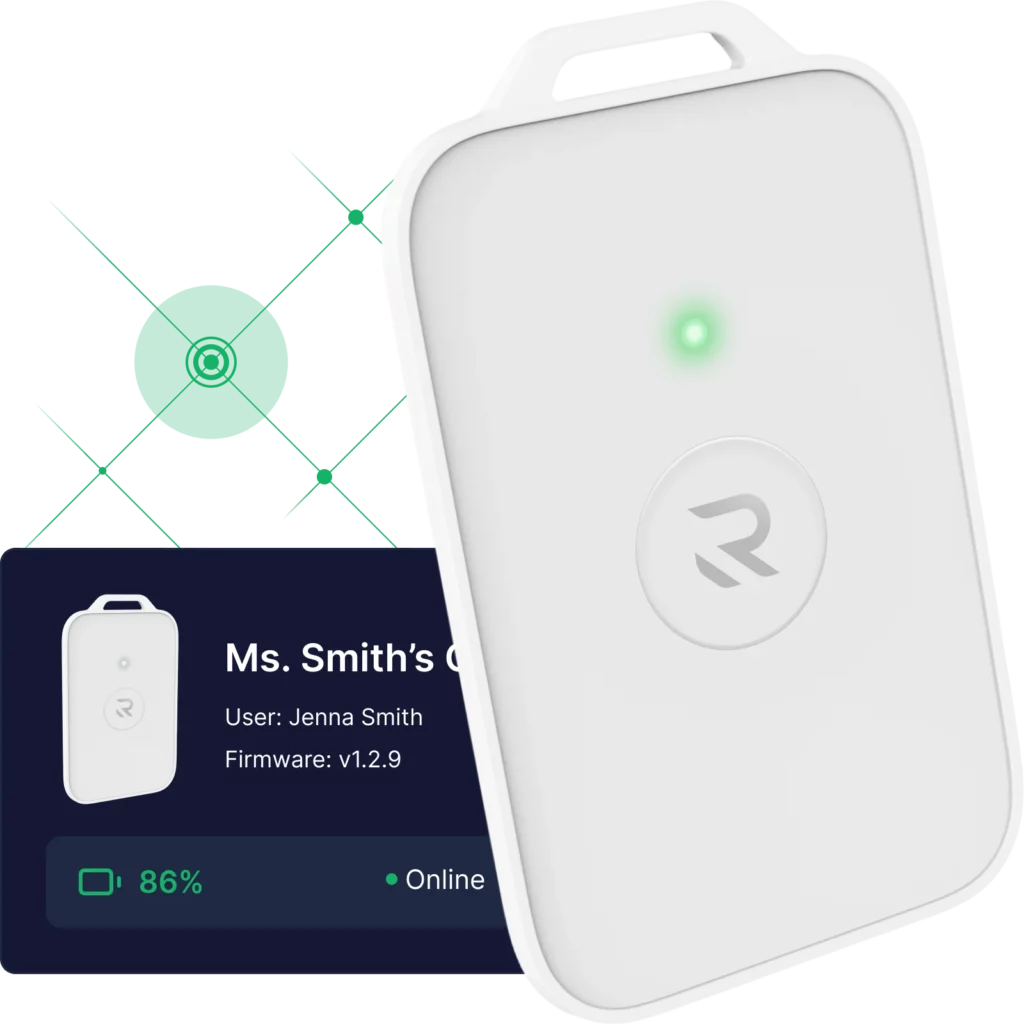
The Rescue Card is a wearable panic button worn by teachers and staff. When pressed, it silently triggers an emergency alert. There’s no phone required. Rescue Repeaters extend signal coverage across a campus. This covers classrooms, gymnasiums, portable buildings, and outdoor areas where WiFi dead zones are common.
The Rescue Base Station anchors the system’s communication infrastructure, with approximately six hours of battery backup to maintain operation during power disruptions. This hardware is designed to work where app-based systems routinely fail, in the areas of campus with weak or no WiFi signal. These are precisely the spaces where staff are most vulnerable and least able to reach a phone.
Punch Rescue integrates with RapidSOS, a platform that connects activated panic button alerts directly to 911 and public safety agencies. The moment a Rescue Card is pressed, RapidSOS transmits real-time incident data (including location and alert type) to the appropriate dispatch center. This directly satisfies A764’s requirement that the panic alarm be directly linked to local law enforcement authorities.
Punch Rescue integrates with Mappedin to embed dynamic indoor facility maps directly within the response dashboard. When an alert is triggered, first responders receive accurate, room-level location data. This gives law enforcement the building-level information they need to respond effectively the moment they are notified.
Punch Rescue integrates with Lightspeed Notify for emergency communication coordination, automated response plan distribution, and mass notifications. When an incident occurs, administrators, staff, and first responders receive the right information automatically. There are no manual steps required during a moment of crisis.
New Jersey’s compliance structure is more demanding than most states, and the consequences of falling short are concrete. When evaluating systems, you need to ask:
Punch Rescue is built to answer yes to all of the above. It’s also highly customizable to meet unique school district needs and specifications.
Yes. New Jersey’s Alyssa’s Law, A764, requires every public elementary and secondary school building to have at least one silent panic alarm directly linked to local law enforcement. Signed February 6, 2019 and effective September 1, 2019, it was the first Alyssa’s Law in the country.
A764 requires a silent alarm meeting National Fire Protection Association (NFPA) and Underwriters Laboratories (UL) standards, installed by a licensed alarm contractor. Compliance is building-by-building, not district-wide. Every school building needs its own certified system.
Compliance isn’t self-reported. Districts submit each building through the New Jersey School Development Authority (NJSDA) via the NJDOE EWEG system. The NJSDA issues a certification of compliance, a request for further documentation, or a denial.
Yes. A764’s certification process runs building by building through NJSDA, not as a single district-wide approval. A district with ten buildings needs ten separate certifications on file.
The federal BJA STOP School Violence Program is the primary avenue. Dedicated state-level funding is limited. Grant cycles and match requirements change year to year. Contact Punch Rescue to confirm current funding pathways for your district.
Punch Rescue’s Rescue Card, paired with RapidSOS 911 connectivity, is built to satisfy A764’s silent, law-enforcement-linked alarm requirement. Because NJSDA certification is building-specific and reviewed case by case, reach out to Punch Rescue’s sales team to confirm current certification documentation for your district’s application.
New Jersey was the first state in the country to pass Alyssa’s Law, and its compliance process remains the most administratively rigorous. Every school building must be individually certified through the state. That certification gates access to grant funding.
Most panic buttons leave you guessing about device status, battery life, and system health. Punch Rescue provides real-time visibility across your entire infrastructure, so you know your school is ready when it matters most.