- Bill: S7132A
- Read the Full Legislation

New York S7132A requires school districts, when reviewing their district-wide school safety plans, to consider the installation of a panic alarm system. A qualifying panic alarm system is defined as:
Note: New York’s law is currently permissive, not mandatory. School boards are required to consider panic alarm systems as part of their safety planning. They are not required to install them.
Alyssa’s Law is state legislation aimed at giving K-12 schools a silent, direct line to 911 during an emergency. New York’s version doesn’t mandate installation yet. It requires districts to formally consider and document a panic alarm system as part of their safety planning.
Not yet, in the mandatory sense. New York’s Alyssa’s Law, S7132A, requires districts to consider installing a panic alarm system during their safety plan review and document that evaluation. This is a “consider,” not a “must install,” standard, though funding is already available for districts that act now.
Alyssa’s Law is named for Alyssa Alhadeff, a 14-year-old student killed in the February 14, 2018 shooting at Marjory Stoneman Douglas High School in Parkland, Florida. Her parents became leading voices pushing for school safety reform. They are advocates for legislation that would give every classroom a direct, silent line to law enforcement during an emergency (without triggering school-wide alarms that could escalate danger or tip off a threat).
Governor Kathy Hochul signed Senate Bill S7132A on June 23, 2022. The bill was introduced by Senator Elijah Reichlin-Melnick. It passed with bipartisan support. Governor Hochul noted at signing, “I am proud to put pen to paper on Alyssa’s Law, a real and meaningful piece of legislation that will require school districts to evaluate systems that can save precious minutes and lives in the event of an active shooter situation.”
All public school districts in New York are subject to the law’s consideration requirement. The law applies as part of the district-wide school safety planning process.
New York’s version of Alyssa’s Law is rather permissive in its current form. S7132A merely requires school districts, when reviewing their district-wide safety plans, to consider the installation of panic alarm systems. These are defined as silent security system signals generated by the manual activation of a device. They are intended to signal a life-threatening or emergency situation requiring a law enforcement response.
The “consider” language is deliberate. New York’s approach mirrors the early-adoption path taken by Virginia and Oregon. It authorizes and encourages action, while stopping short of providing a mandate. That said, the practical pressure on districts is real. School boards that have considered and documented a decision not to install panic alarms are in a very different position than boards that have never formally addressed the question. The district-wide safety plan is a public document, and the decision to forgo panic alarms is one communities increasingly scrutinize.
New York’s permissive law reflects where many states start, but not where they end up. New Jersey passed a permissive version before tightening it into a full mandate. Florida mandated a single panic alarm per school before requiring PSAP integration. The legislative arc across states is often that consideration requirements give way to installation mandates. Later, installation mandates tend to give way to more specific technical requirements. This pattern suggests that districts that act now, while the timeline is their own, will be better positioned than those that wait for a mandate to force the decision.
As with other states’ versions of Alyssa’s Law, panic alarm systems are additions to a school’s safety infrastructure. They’re not replacements for existing classroom phones, intercoms, or other established communication devices.
Alyssa’s Law has now passed in many states. This includes New Jersey (2019), Florida (2020), New York (2022), Texas and Tennessee (2023), Utah and Oklahoma (2024), Georgia, Washington, and Oregon (2025), and Virginia and West Virginia (2026). As of early 2026, more than 18 additional states are actively considering legislation.
New York sits at the permissive end of the spectrum alongside Virginia and Oregon. The law establishes a framework and a definition. It stops short of requiring installation. That puts New York well behind states like Florida, Texas, and Georgia. All of these states have moved from permissive language to operational mandates. Some states that passed Alyssa’s Law around the same time as New York have significantly raised their own bar since.
New York districts that treat S7132A as a checkbox, documenting that they “considered” panic alarms without acting, are taking on increasing risk as the national standard rises.
New York schools can stack multiple funding sources to cover the cost of a qualifying panic alarm system.
The Smart Schools Bond Act includes a High-Tech Security features category that covers silent panic alarm systems and related security technology. Districts that have not yet submitted a Smart Schools Investment Plan (SSIP) amendment to include panic alarm technology should consult with the New York State Education Department (NYSED) to confirm their current eligibility and application windows.
The BJA STOP School Violence Program reopened its FY2026 cycle on September 21, 2026. It now offers 15 awards of up to $2 million each for state governments and public institutions of higher education (Category 1). It also offers 80 awards of up to $1 million each for local governments, school districts (including public charter schools), nonprofits, private K-12 schools, and tribal governments (Category 2). It is a 36-month award. The Grants.gov deadline is October 30, 2026, and the JustGrants deadline is November 6, 2026.
New York’s funding landscape allows districts to stack SSBA and federal grant sources. This is a meaningful advantage for districts looking to build a comprehensive system rather than meet a minimum threshold.
Punch Rescue provides resilient hardware and software designed to work when it matters most. For New York schools, that means a silent panic alarm system that satisfies S7132A’s definition of a qualifying device. It is built to meet the more demanding requirements likely to follow as the law evolves.
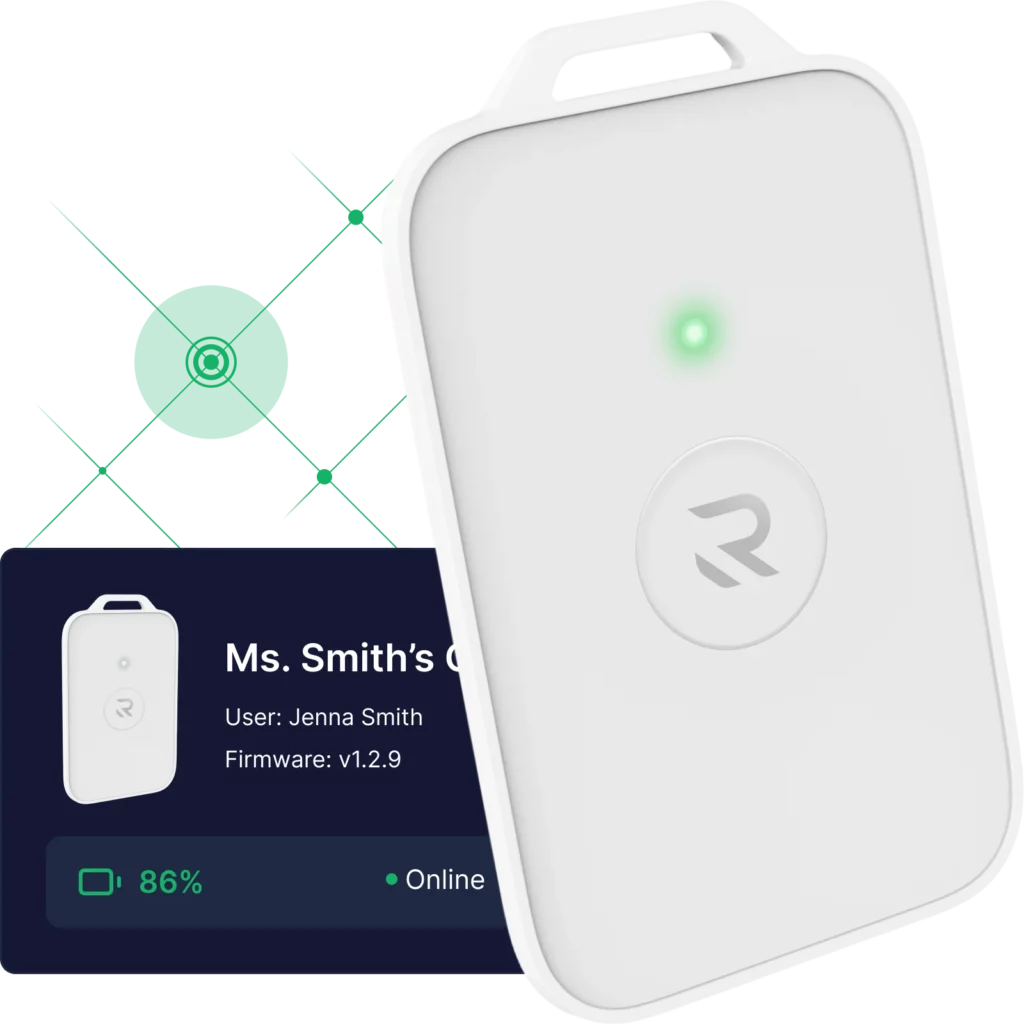
The Rescue Card is a wearable panic button worn by teachers and staff. When pressed, it silently triggers an emergency alert. There’s no phone required. Rescue Repeaters extend signal coverage across a campus. This includes classrooms, gymnasiums, portable buildings, and outdoor areas where WiFi dead zones are common. The Rescue Base Station anchors the system’s communication infrastructure, with approximately six hours of battery backup to maintain operation during power disruptions.
Punch Rescue integrates with RapidSOS. This is a platform that connects activated panic button alerts directly to 911 and public safety agencies. The moment a Rescue Card is pressed, RapidSOS transmits real-time incident data (including location and alert type) to the appropriate dispatch center. This satisfies S7132A’s definition of a panic alarm system as a device intended to signal a life-threatening emergency requiring a law enforcement response.
Punch Rescue integrates with Mappedin to embed dynamic indoor facility maps directly within the response dashboard. When an alert is triggered, first responders receive accurate, room-level location data. This feature can position New York schools ahead of the more specific location data requirements that are emerging in other states.
Punch Rescue integrates with Lightspeed System’s Notify technology for emergency communication coordination, automated response plan distribution, and mass notifications. When an incident occurs, administrators, staff, and first responders receive the right information automatically. No manual steps are required during a moment of crisis.
New York’s permissive law means the decision is currently yours to make. When evaluating your system options, you need to ask:
Punch Rescue is built to answer affirmatively to all of the above. It’s also highly customizable to meet unique school district needs and specifications.
Not yet in the mandatory sense. New York’s Alyssa’s Law, S7132A, effective June 23, 2022, requires school districts to consider installing a panic alarm system as part of their district-wide safety plan review. This is a “consider,” not a “must install,” standard.
A silent security system signal, generated by manual activation, intended to signal a life-threatening or emergency situation requiring a law enforcement response (not a general intercom or school-wide alarm).
Yes. Districts that don’t document what they evaluated and why during the safety plan review may not be meeting even the permissive standard S7132A sets. The documented evaluation is the actual legal requirement, not installation.
Yes. The Smart Schools Bond Act’s (SSBA) High-Tech Security features category covers panic alarm systems as an eligible expense, alongside federal BJA STOP School Violence Program funding.
Between SSBA High-Tech Security allocations and BJA STOP grants, most districts can fund a system without waiting for a mandate. Eligibility and remaining allocations change. Districts should consult NYSED directly to confirm current SSBA eligibility, and reach out to Punch Rescue to confirm current grant-application support.
Punch Rescue’s Rescue Card system, with direct RapidSOS 911 connectivity, satisfies S7132A’s definition of a qualifying silent panic alarm. Contact Punch Rescue’s sales team to confirm current documentation districts can attach to their safety-plan review.
New York requires school districts to consider installing panic alarm systems as part of their district-wide safety planning. The law is still fairly permissive, with the technical standard clearly defined and funding made available.
Most panic buttons leave you guessing about device status, battery life, and system health. Punch Rescue provides real-time visibility across your entire infrastructure, so you know your school is ready when it matters most.